Saturday, June 29, 2019

Boats at Burritts Rapids

I visited the Burritts Rapids lock station on Friday, June 28, 2019 as I am working on photographing all the lock stations in the Rideau Canal system for my blog site, Memorials in Ottawa. The Rideau Canal System is a UNESCO World Heritage Site and as such every part of it certainly satisfies the criteria for inclusion in the Memorials in Ottawa site.

As part of my visit I walked the Tip To Tip Trail (4 kilometer round trip) to photograph the swing bridge in Burritts Rapids and the dam and weir on the other side and at the far end of the island. While doing all that I photographed a few boats.


Wednesday, June 05, 2019

Bonhomme Richard

This is the very very small kit from Heller Cadet in 1:500 scale of the 1765 sailing ship named BONHOMME RICHARD. The first release was in 1964 as Heller L060. It probably had solid plastic sails. This slightly later version has vacuform thin plastic sails meant to be cut out and hung.

The original vessel was a merchantman trader for the French East India Company named Duc de Duras which managed two trips to China before being bought by the king of France.

The French king gave the ship to the new USA government as a war loan in February 1779, and by September that same year  it had been sunk by the British Royal Navy off north Yorkshire in the battle of Flamborough Head.

But it lived on when the captain of the Bonhomme Richard managed to capture the victorious warship HMS Serapis and sail it as a pirated vessel to the Dutch port at Texel where they made a new US flag from faulty memory and a description in a book in order not to be seized as a pirated vessel. The Texel or Serapis flag is the most unusual of the early US national flags.

Paint is a Tamiya spray white primer on the hull, and sand colour on the deck. Everything else is Vallejo acrylics. I cut off the original yards from the side of the masts and built new yards from plastic rod and from metal wire. The vacuform sails are hung from these. The rigging is sewing thread, and the vacuform sails are from the kit. I built the gold captains cabin section onto the stern of the ship as the original kit had only a flat stern. I built two additional yards and sails from the vacuform material for the two sails hung under the bowsprit as these show up in paintings and museum models. There are nice very tiny cannons on the decks.

I made all three flags by printing tiny images in colour regular and flipped so when glued together the flag would face the correct way from the mast. Flags include the best representation of what was the US national flag in 1779; the "first navy jack" of the US Navy (Don't tread on me); and the Texel or Serapis flag on the stern. It would not have been possible for the BHR to fly the Texel flag as the ship had already been sunk - but it is flown as an historical marker of the event.

I bough the kit at a flea market in Ottawa for $4, and finished it in 8 days. John Clearwater.


Sunday, April 14, 2019

May 2019 Meeting

Capital Marine Modellers' Guild will meet, for the last meeting of the 2018-2019 season, on Tuesday May 7, 2019 at 7 p.m., at the Nepean Museum, 16 Rowley Avenue, Nepean. Look forward to some interesting show and tell items.


Thursday, April 11, 2019

Chinese JUNK sailing vessel

This is the very old (1956) Aurora plastic model of a Chinese JUNK sail boat. For a model tooled in 1956 it is surprisingly good.

The word "junk" may be derived from the Chinese word   meaning boat or ship or sailing vessel, but more probably from a Malay word for boat later used by the Chinese. Generally it means a boat with fully-battened sails. The type reached its apex in the 15th - 17th century.

The basic wood colour is Vallejo's mahogany weathered with oil pastels. The plastic masts were replaced with wooden masts, then it was fully rigged. More coiled rope will be added, as will some general cargo on deck. The truly hideous base will be replaced with almost anything which is not as awful, or at least painted as a temporary solution.

It is very difficult to photograph something this dark. Work in progress... by John Clearwater


Wednesday, April 03, 2019

Hikawa Maru - Ocean Liner Museum - Yokohama, Japan

The Hikawa Maru is the surviving ship from a trio built for Pacific crossings between Japan and the USA in the 1930s. Built in Yokohama, it sailed from that port, and is now a floating museum ship berthed in Yokohama. She sailed from 1930 until December 1960, making 258 crossing and carrying 25000 passengers, including the Japanese royal family.

Hasegawa model company puts out two different models of the ship, including one configured as a red cross hospital ship during the Pacific War.

Photos by John Clearwater, October 2017.

Hikawa Maru

Heian Maru (the sister ship) model by John Clearwater

Hikawa Maru

Hikawa Maru

Hikawa Maru

Hikawa Maru

Hikawa Maru

Hikawa Maru

Hikawa Maru

Hikawa Maru

Hikawa Maru

Hikawa Maru

Hikawa Maru

Hikawa Maru

Hikawa Maru with John Clearwater

Hikawa Maru

Hikawa Maru

Hikawa Maru

Hikawa Maru

Hikawa Maru

Hikawa Maru


Winning Wooden Boat Models - Heritagecon-13

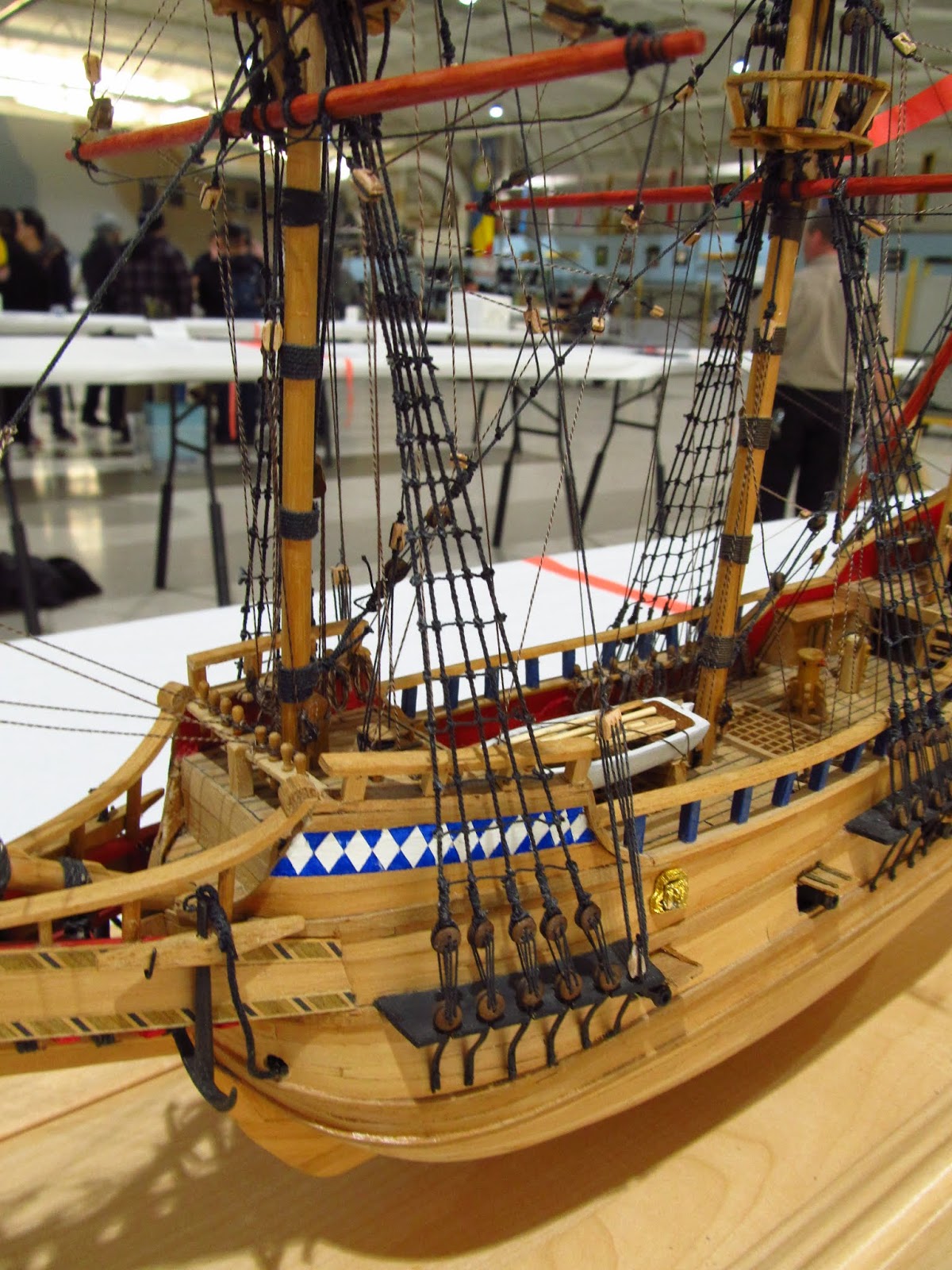
These are the first and second place winners in the wooden boat category at the Heritagecon-13 plastic model contest at the Canadian Warplane Heritage museum in Hamilton on Sunday 24 March 2019. The winner is Henry Hudson's HALVE MAEN (Half Moon) which belonged to the Dutch East India Trading Company, and sailed into what is now New York harbour in 1609. The second place winner was made from scratch from plans in a book called "The Marisol Skiff".


Halve Maen

Halve Maen

Halve Maen

Halve Maen


The Marisol Skiff

RMS Queen Mary Pre-Naming Medal

The medal, or more properly, the medalet, is a commemorative item from Glasgow's Daily Record newspaper, and was issued before the ship was named. So it does not carry the still unknown name, but rather the hull number of 534. 26 September 1934 is the launch date.

"Daily Record medalet commemorating RMS 534 ('Queen Mary'). Obverse: Busts conjoined of King George V and Queen Mary (left). Reverse: Port-bow view of the liner, figure 534. Legend: 'DAILY RECORD MEDAL. SEPTEMBER 26TH 1934.' The 'Queen Mary' was launched in 1934 having been built by John Brown & Company, Clydebank. 534 was her yard number. The 'Daily Record' is a Glasgow published newspaper."  (Royal Museums Greenwich)

It is 32 mm wide, weighs 4 grams, and is made of tin.

There are currently many for sale on-line for about $18.


Tuesday, April 02, 2019

Project 949A Antey Submarine

This is the Dragon 1:700 scale submarine kit of the USSR's gigantic cruise missile-carrier called Project 949A Antey (Проект 949А Антей).

 The ship is the K-410 Smolensk, built in the late 1980s and currently in service with Russia's Northern Fleet. The main armament was the P-700 3M45 Granite (Гранит) anti-ship cruise missile, but this is being phased out and replaced by the ultra-modern 3M54 Calibre (Калибр), which being smaller can be carried in greater numbers in each launch cell.

 The paints are all Vallejo acrylics and washes. The plastic masts were replaced with steel wire. This was a fun weekend project.

John Clearwater

Project 949A Antey (Проект 949А Антей)  "Smolensk"

Project 949A Antey (Проект 949А Антей)  "Smolensk"

Project 949A Antey (Проект 949А Антей)  "Smolensk"

Project 949A Antey (Проект 949А Антей)  "Smolensk"

Soviet Naval Anti-Submarine Warfare Detachment

Soviet Naval Anti-Submarine Warfare Detachment in the Black Sea, circa 1984.

I think I built this over 20 years ago from two different Dragon box sets of 1:700 scale Soviet naval vessels.

The main ship is a Project 1134B Berkut B (Golden Eagle) "large anti-submarine warfare ship" named Nikolayev. It was the lead ship of the Berkut-class large ASW ships. It was commissioned new year's eve 1971, and would become a Ukrainian Navy ship after 1991. It did not continue in service and was soon scrapped in India in 1994.

The Nikolayev is escorted by two Project 1234 Ovod Small Missile Ships.

It is all hand-painted. The base is wood with an artists oil paint water surface.

The photos are scans of old printed photos. Sorry about the image quality.

John Clearwater

Soviet Naval anti-Submarine Warfare Detachment - Black Sea, 1984

Soviet Naval anti-Submarine Warfare Detachment - Black Sea, 1984

Project 1134B Berkut B (Golden Eagle) named Nikolayev.