Saturday, October 23, 2021

HMS Repulse and HMS Prince of Wales, in 1:700 scale

HMS Repulse and HMS Prince of Wales, in 1:700 scale, by Chris Flodberg.


Wednesday, October 06, 2021

RUSSIAN NAVAL GUN

Russian naval cannon in about 1:25 scale from an unknown model company in China through AliExpress. The gun and fittings are metal and the carriage and base are wood. There is a selection of photo etch brass parts. I cut the base down from being a massive circle to something which will more easily fit in a cabinet. The instructions leave a lot to be desired. I started this kit maybe four years ago and abandoned it because of the two large metal sprue attachment points under the barrel which would show up in the finished model. I was unable to grind them off with a power tool so stopped work. Then last week I thought to just use a metal file, and within ten minutes the points were gone, so I sprayed it with Tamiya metal primer then a DIY store satin finish black. The imperial crest on the cannon is well done, and was brought out by sanding and scraping the paint away to reveal the goldish brass beneath. The water in the bucket is blue paint later covered with a drop of epoxy cement which dries like a layer of water.    John Clearwater


Wednesday, September 01, 2021

RMS MAURETANIA (Airfix)

Cunard had Swan Hunter build this record-breaking ocean liner in 1906 as a twin with RMS Lusitania. Unlike the second ship, the RMS Mauretania (named after the Roman province of North-West Africa) served for 27 years, and held the Blue Riband speed record on the North Atlantic for 20 years with a speed of nearly 50 km/hr. It was the first ocean liner to utilize steam turbines instead of pistons to carry over 2160 passengers across the Atlantic in five days. It was the largest ship in the world until 1910.
This is the very old (1964) and very rough Airfix kit, and was part of a series of kits of British ocean liners. The whole build was an exercise in nostalgia, as I attempted to imagine myself as a small boy who received a paper-wrapped kit in about 1966 and proceeded to glue it all together and paint it from little pots of British Humbrol paints. It all went together in a week and was very much the fun model build of a child. Smoke is cotton wool with Vallejo soot powder.     John Clearwater

RMS Mauretania

RMS Mauretania
 
RMS Mauretania

Friday, May 07, 2021

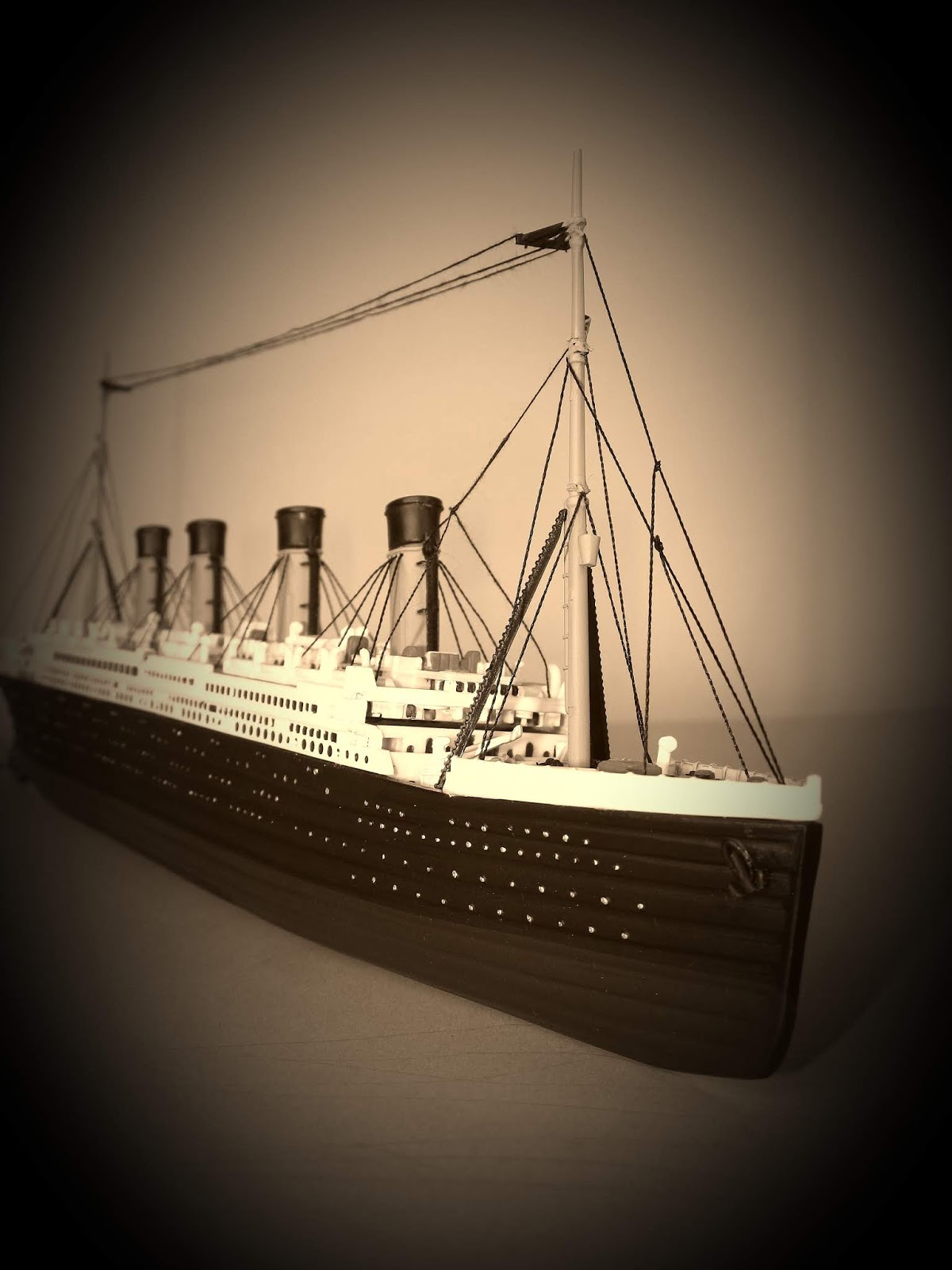
R.M.S. TITANIC (Suyata)


This is the very new first model from a new Hong Kong company called Suyata Models. The kit (SL001) is a cartoon version of that spectacular failure of a ship, the R.M.S. Titanic, or as The Onion put it, "the World's Largest Metaphor".  
This is a superb kit in so many respects. The moulding is beautiful and the fit fantastic. It is cast in four colours, but I still painted everything using various Vallejos and Tamiya gloss white acrylics.
Witht he kit I also bought the laser cut wooden decking. There were about 25 pieces of decking, and I took the better part of a day applying it after first sticking it to my fingers. However, it was a great way to learn about applying wooden decking to model ships. There was no decking for the aft flying bridge so I used excess wood to make proper decking for that piece. I also added chain for the anchors; rigging; a sternpost flag; and filled in all the portholes with clear glue.
Here is my first-view pre-build in-box review: https://www.youtube.com/watch?v=KjsfoTdB2cU
The Onion says this was the final transmission from the Titanic: "Titanic struck by icy representation of nature's supremacy STOP insufficient lifeboats due to pompous certainty in man's infallibility STOP Microcosm of larger society STOP". Strangely there are almost as many lifeboats in this cartoon kit as there were on the real ocean liner.
John Clearwater


Work-in-progress in the Harland and Wolff shipyard in Belfast,
which just so happens to be in my spare bathroom...


Saturday, February 27, 2021

March 2021 Virtual Zoom Meeting

Capital Marine Modellers' Guild will have a virtual Zoom meeting on Tuesday, March 2, 2021 from 7 p.m. to 9 p.m.

Please contact club management by email for information on how to participate.

cmmgottawa@gmail.com 


Tuesday, January 26, 2021

February 2021 Virtual Zoom Meeting

Capital Marine Modellers' Guild will have a virtual Zoom meeting on Tuesday, February 2, 2021 from 7 p.m. to 9 p.m.

Please contact club management by email for information on how to participate. cmmgottawa@gmail.com


Monday, January 18, 2021

U.S.S. Monitor

This is the 1:210 scale model from Life-Like Hobby Kits of the U.S.S. Monitor (kit #09527). The ship is most famous for being the first turreted iron-clad warship to engage in combat with another iron-clad, the CSS Virginia, on 09 March 1862. The lower and faster Monitor had the advantage, but the Battle of Hampton Roads saw neither emerge victorious. The Monitor could fire the two Dalhgren guns every eight minutes. The battle lasted about four hours. The ship had a life of only eleven months when lost in a storm while being towed.
This kit is remarkably simple and needed almost no bodywork other than drilling out of vents and grills and boring the cannons. I added the cannon flash and smoke from the funnels and the gun. Paint is a mix of Vallejo burned iron and jet exhaust, with a mix of Tamiya reds for the iron hull. The toughest thing to paint was the flag.
This comes boxed with the CSS Merrimac (actually the CSS Virginia) in 1:300 scale. The Virginia is so much larger that the makers decided to make both hulls the same size by altering the scales.
John Clearwater


C.S.S. VIRGINIA

This is the old 1970s 1:300 scale model from Life-Like Hobby Kits of the Merrimac, or more properly, the C.S.S. Virginia, iron-clad steam ship (kit #09257). The Virginia was made from an older vessel, the USS Merrimack, in 1862 and had a life span of just under 90 days. It was built to break the blockade around the slave staes by ramming United States' ships and sinking them. The response from the USA was to send the USS Monitor to battle the Virginia at the Battle of Hampton Roads on 09 March 1962 - the first ever battle of iron-clad vessels. The Virginia limped out for repairs and was eventually scuttled.
The design and moulding is atrocious. The upper structure does not fit properly at all, and the upper deck is a disaster. You need significant skills to be able to assemble this kit.
The decks were scraped and sanded to remove the iron plate and rivet raised lines, then engraved with board lines. Chains were added. Cannons were bored out.
Paint is Vallejo burned iron and jet exhaust for the superstructure; with a mix of Tamiya paints for the hull.


Tuesday, December 29, 2020

January 2021 Virtual Zoom Meeting

Capital Marine Modellers' Guild will have a virtual Zoom meeting on Tuesday, January 5, 2021 from 7 p.m. to 9 p.m.

Please contact club management by email for information on how to participate. cmmgottawa@gmail.com


Saturday, December 26, 2020

DAHLGREN NAVAL GUN (Verlinden)

It took about six years, but I finally started and finished this Verlinden model #1422 in 1:35 scale of a U.S. Navy Dahlgren 11-Inch Naval Gun this past week. Verlinden of Belgium went out of business in 2016, and the price of their kits has skyrocketed. I paid about $30 for this kit some six years ago. Now it is on ebay for $300. Insanity!

The kit is all resin, so working with it is dangerous in terms of toxic particles. Always wear a particle filter mask. All paints are Vallejo and Tamiya and ModelMaster/Testors acrylics. The kit was missing the necessary amount of pulley rope, so that came from my spare ship parts container.

Wiki says: "Dahlgren guns were muzzle-loading naval artillery designed by Rear Admiral John A. Dahlgren USN (1809 – 1870), mostly used in the period of the U.S. Civil War. Dahlgren believed a safer, more powerful naval cannon could be designed using more scientific design criteria. Dahlgren guns were designed with a smooth curved shape, equalizing strain and concentrating more weight of metal in the gun breech where the greatest pressure of expanding propellant gases needed to be met to keep the gun from bursting. Because of their rounded contours, Dahlgren guns were nicknamed "soda bottles", a shape which became their most identifiable characteristic.  XI-inch Dahlgren shell gun: 465 were cast at (various locations) between 1856 and 1864. This is the only Dahlgren gun to have been designed both with and without a muzzle swell. The gun was typically mounted on a pivot or in a turret on a monitor. When mounted in a turret, the crew for an XI-inch Dahlgren was seven including powdermen. The crew for the gun when mounted on a pivot was 24 men and a powderman. XI-inch Dahlgrens were carried on (various ships) and monitors as well as the original USS Monitor. Many other conventional ships carried XI-inch Dahlgrens on pivot mounts. A few larger river gunboats also carried XI-inch Dahlgrens."

This version fired a 280 mm, 75 kg ball, about 1000 m.

John Clearwater


inbox review TITANIC Seal & Iceberg Scene

This is a first look in the box of the new TITANIC egg/cartoon scale model released in 2020. TITANIC SEAL & ICEBERG SCENE, from Suyata (HK) International Co., Ltd, of Hong Kong (kit #SL001). The kit is not officially available in North America due to lack of a distributor, but I acquired this one from the factory in China. It arrived in about 17 days by post.

Quality and details are excellent. It can be made waterline or full hull version. All parts are moulded in appropriate colours, but any purist will of course paint most everything. Technically it is a snap-together kit, but of course purists will glue everything in place and add rigging. Overall it is 150 mm long. For reasons I do not understand, all of the six seals in the kit have names. Even the small seals are the size of a funnels on the ship. Real wooden decks as extras are available for this Suyata kit on-line for only about $10. The only negative is the lack of decals for the hull. This seems odd given the quality and the decal for the base/stand.

Overall this kit is far and away better than the new Meng cartoon kit of the Titanic, which has fewer parts, fewer decks, and is overall smaller. This would make a great kit to do with a child over a weekend, or for an actual modeller to do up fancy.

My video review on youtube is attached here:
https://www.youtube.com/watch?v=KjsfoTdB2cU

John Clearwater


Friday, October 30, 2020

November 2020 Virtual Meeting

 Capital Marine Modellers' Guild will have a virtual Zoom meeting on Tuesday, November 3, 2020 from 7 p.m. to 9 p.m.

Please contact club management by email for information on how to participate. cmmgottawa@gmail.com

Based on the previous meeting there are a couple of rules to make the meeting better.

1. please mute when joining.
2. Raise your Virtual hand if you want to comment as it stops us from talking over each other.

Sunday, October 04, 2020

CMMG Zoom 2020-2021 Meeting Schedule

Until further notice, due to the Covid-19 pandemic, Capital Marine Modellers' Guild monthly meetings will be Zoom meetings. The following meeting schedule will be in effect for the remaining season, subject to change as circumstances may permit. Please, contact Capital Marine Modeller's Guild at cmmgottawa@gmail.com for information on how to participate in the scheduled Zoom meetings.

Oct 6, 2020 07:00 PM
Nov 3, 2020 07:00 PM
Dec 1, 2020 07:00 PM
Jan 5, 2021 07:00 PM
Feb 2, 2021 07:00 PM
Mar 2, 2021 07:00 PM
Apr 6, 2021 07:00 PM

Tuesday, September 29, 2020

October 2020 Meeting

As the Nepean Museum continues to have covid-19 restrictions in place, it will not be available for an October meeting.

However, a Zoom Meeting will happen.

The Zoom Meeting will take place on Tuesday, October 6, 2020 starting at 7 p.m.

Contact cmmgottawa@gmail.com should you need instructions on how to attend.


Monday, September 28, 2020

MAUDSLAY'S OSCILLATING PADDLEWHEEL ENGINE

This is the bizarre Airfix 1:45 scale model of the 1827 OSCILLATING STEAM ENGINE for a paddlewheel ship as designed and built by Henry Maudslay. The kit was released in 1968 and re-released in 2012. The master for the model is a brass and steel model on display at the Victoria & Albert Museum in London (please see last photo). The originals releases came with a motor and a drive system allowing the whole engine to run. 

Maudslay is considered to be the inventor of the first industrial screw cutting lathe, and of several other machines and technologies essential to the start of the industrial revolution in the early 1800s. This engine was used for a decade to drive two side paddlewheels on a Thames transport ship starting in 1826. In an oscillating engine the piston rods are connected directly to the crankshaft, and the engine cylinders are secured by trunnions in the centre, allowing the cylinders to pivot back and forth with the rotation of the crankshaft. This means it only operates at a low pressure. The real one is quite large, with the height of the cylinder and extended piston rod about the size of a person.

The model comes with a paddlewheel, but it looks awful in comparison with the engine, so I discarded it. All paints are acrylics by Vallejo and Tamiya. The Tamiya silver was the worst silver metal paint it has ever been my misfortune to use, and it was scrapped and washed off using GreenWorks cleaner in a few seconds. The metal was then painted using Vallejo burned iron, and the piston rods rubbed with a silver powder. All brass parts are done with Vallejo 998 Bronze.

John Clearwater

Maudsley's Oscillating Steam Engine

Maudsley's Oscillating Steam Engine


Model of the engine at the V&A Museum in London

Friday, August 28, 2020

No Meeting September 2020

Due to the covid-19 pandemic there has been no word from the Nepean Museum about availability of their facilities for a meeting. There will be no September meeting for the Capital Marine Modellers' Guild. Should the facilities become available for future meetings that will be announced on this site.


TIRPITZ (1:2000 scale)

This is the extremely tiny 1:2000 scale tiny model of the nazi scum battle cruiser/ battleship TIRPITZ which was meant to compete with the growing French navy. This is another in my series of fun and fast build COVID-19 models. I received it as a gift and the lockdown was a great opportunity to get it off the shelf, painted, rigged, and out of here. It was basically a two day build just for fun. The kit (Heller #052) has 46 parts. The model is a tiny 12 cm in length. The real ship was 241.6 m. The base is balsa wood and the water/waves are gesso painted with blue and white.

 The actual ship was launched by Germany in 1939 and commissioned into the navy in 1941. The only real task for the ship was as a raider against convoys moving towards Murmansk and Arkangelsk in the USSR, but even then it only managed two missions. It spent most of its operational life essentially in hiding -- blanketed in artificial fog, or covered by a forest of trees to evade British heavy bombers! Tirpitz was eventually sunk by RAF Lancaster bombers on 12 November 1944. More than a thousand crewmen died in the explosions and capsizing.

John Clearwater

nazi scum battle cruiser TIRPITZ

nazi scum battle cruiser TIRPITZ

nazi scum battle cruiser TIRPITZ

nazi scum battle cruiser TIRPITZ

nazi scum battle cruiser TIRPITZ

nazi scum battle cruiser TIRPITZ

Saturday, May 30, 2020

June 2020 Meeting - cancelled

Due to the ongoing health crisis the 02 June 2020 meeting of the Capital Marine Modellers' Guild has been cancelled. Meetings will resume when the City of Ottawa re-opens all public facilities. Also, the annual dinner has been postponed until further notice.

Keep working in your home shipyard, and let's see a lot of finished models when this is all over.


R.M.S Titanic (1:800)

This is the simply awful kit from an un-named Chinese company, of the White Star Line's R.M.S. Titanic in 1:800 scale. The kit is moulded in three colours: almost none are usable. Quality of the mouldings is appalling. Detail is bad. Fit is poor. Design concept is ill-considered. Decals are plastic stickers which cannot be used.

Titanic was one of three sister ships, and was laid down in March 1909 and launched in May 1911. It was completed in April 1912 and sank on it's maiden voyage on 15 April 1912. Poor design; lack of appropriate lifeboats and lifeboat spaces; poor work by Harland & Wolff of Ireland; a major fire in the hull which burned for two days in the yard; and crass corporate disdain for safety by White Star and Bruce Ismay led to the deaths of 531 third class passengers as well as 155 second class passengers (mostly servants). There were 34 Canadians on board, mostly in first class. All Canadians in third class died, as did half of those in first and second class.

Survivors and families in the USA and UK grouped together to sue White Star for $16 million ($418 million today), but because the US Supreme Court interfered on behalf of White Star to limit the liability, White Star ended up paying only a mere $664 000. (or about $16 million today) in compensation to mostly US passengers. Compensation did not go to non-UK or non-US citizens, and nothing went to third class passengers.

The criminal actions of the White Star company were never prosecuted, and company director Bruce Ismay (who survived the sinking) remained free. White Star did not survive the great depression, and was bought by Cunard with British government bailout money in 1933.

John Clearwater

White Star R.M.S TITANIC (1912)  1:800 scale

White Star R.M.S TITANIC (1912)  1:800 scale

White Star R.M.S TITANIC (1912)  1:800 scale

White Star R.M.S TITANIC (1912)  1:800 scale